How To Cure Procrastination So Quickly It Feels Illegal
Overview
Topic: Procrastination and productivity
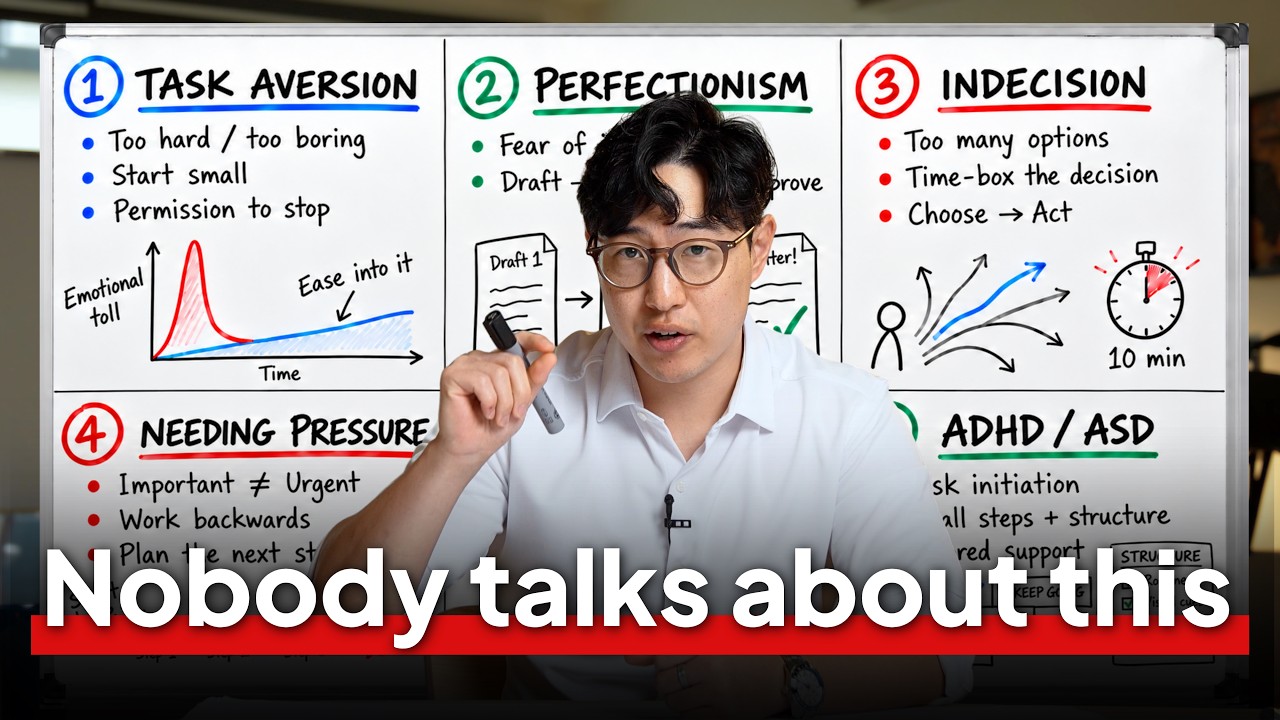
In this video, Dr. Justin Sung explores the neuroscience of procrastination and provides a comprehensive framework to overcome it. He explains that procrastination is not a single behavior but a set of behaviors driven by different mechanisms. He defines procrastination as a state where the emotional toll of a task exceeds one's tolerance for it. He outlines six distinct types of procrastination: innate task aversion, task implications (such as perfectionism), decisional procrastination, pressure dependence, generalized anxiety, and ADHD/ASD. For each type, he offers practical, science-based solutions, such as leveraging the Zeigarnik effect, using drafts and feedback to lower the risk of judgment, timeboxing decisions, and utilizing reverse goal setting to create a healthy sense of urgency.
Minute by Minute (22)
[00:00 - 01:00] Introduction to Procrastination
Dr. Justin Sung introduces the topic of procrastination, explaining that he will share a framework based on neuroscience and research to help make procrastination functionally obsolete.
[01:00 - 02:00] The Procrastination Equation
He defines procrastination as when the emotional toll of a task exceeds one's tolerance for it, and introduces the six main types of procrastination.
[02:00 - 03:00] Innate Task Aversion
He discusses the first type of procrastination, which is innate to the task itself, where the task process is perceived as highly aversive.
[03:00 - 04:00] Examples of Aversive Tasks
He gives examples of aversive tasks, such as difficult conversations or dentist appointments, and explains how we predict a high emotional toll at the start.
[04:00 - 05:00] The Zeigarnik Effect
He introduces the Zeigarnik Effect, which states that unfinished tasks are easier for the brain to return to than starting from scratch.
[05:00 - 06:00] Applying the Zeigarnik Effect
He explains how to deliberately start a task and leave it unfinished to lower the activation energy for the next session.
[06:00 - 07:00] Benefits of the Zeigarnik Effect
He details the benefits of this effect, including breaking inertia and building momentum, using laundry as a personal example.
[07:00 - 08:00] Mindset for Zeigarnik Effect
He emphasizes that you must genuinely give yourself permission to stop after doing just a little bit, rather than trying to trick yourself.
[08:00 - 09:00] Summary of Zeigarnik Benefits
He summarizes the three main benefits of the Zeigarnik effect and introduces his newsletter.
[09:00 - 10:00] Newsletter and Next Type
He discusses his newsletter topics and transitions to the second type of procrastination: the implication of the task.
[10:00 - 11:00] Perfectionism and Insecurity
He explains that perfectionism is not about high standards but about insecurity and fear of judgment.
[11:00 - 12:00] Overcoming Perfectionism
He suggests leveling out the risk of judgment by creating drafts and seeking frequent feedback early on.
[12:00 - 13:00] Owning Vulnerability
He explains how creating drafts allows you to own your vulnerability and turn judgment into constructive feedback.
[13:00 - 14:00] Decisional Procrastination
He introduces the third type: decisional procrastination, which occurs when there is too much uncertainty about how to do a task.
[14:00 - 15:00] Timeboxing Decisions
He suggests timeboxing decisions to limit the time spent overthinking and force a choice.
[15:00 - 16:00] Pressure-Dependent Procrastination
He introduces the fourth type: pressure dependence, where people rely on deadlines to force action.
[16:00 - 17:00] Strategic Delay vs. Rationalization
He distinguishes between strategic delay (healthy prioritization) and rationalization (unhealthy reliance on pressure).
[17:00 - 18:00] Distant Horizon Rewards
He explains that humans struggle with long-term rewards and suggests reverse goal setting to make long-term goals feel urgent.
[18:00 - 19:00] Reverse Goal Setting
He explains how reverse goal setting provides a realistic scope of work and creates a healthy sense of urgency.
[19:00 - 20:00] Anxiety and ADHD
He briefly covers the final two types: generalized anxiety disorder and ADHD/ASD, recommending professional help for these.
[20:00 - 21:00] Conclusion and Summary
He summarizes the six types of procrastination and encourages viewers to identify their specific type to apply the right solution.
[21:00 - 22:25] Final Tips on Decision Making
He shares a final tip on making important decisions when the prefrontal cortex is fresh, rather than fatigued at the end of the day.
Full video: Watch on YouTube