نص حلقة: Give Me 18 Minutes, and You’ll Learn Faster Than 99.9% of People
Justin Sung2026-10-09
Give Me 18 Minutes, and You’ll Learn Faster Than 99.9% of People
Overview
Topic: Learning Strategies
In this video, Justin Sung discusses the two simplest and most effective methods for learning faster: prediction errors and multipass encoding. He explains the difference between coverage speed and time to outcome, emphasizing that true learning speed is about reaching mastery in less total time. He then details how to implement prediction errors by making active predictions before reading, and how multipass encoding leverages prior knowledge to make complex topics easier to understand over multiple passes.
Minute by Minute (18)
[00:00 - 01:00] Introduction to Faster Learning
Justin Sung introduces the topic of learning faster and outlines the two simplest methods he will discuss: prediction errors and multipass encoding.
[01:00 - 02:00] Redefining Learning Speed
Justin explains that many people waste time looking for the perfect technique because they define 'faster' incorrectly, focusing purely on coverage speed.
[02:00 - 03:00] Coverage Speed vs. Time to Outcome
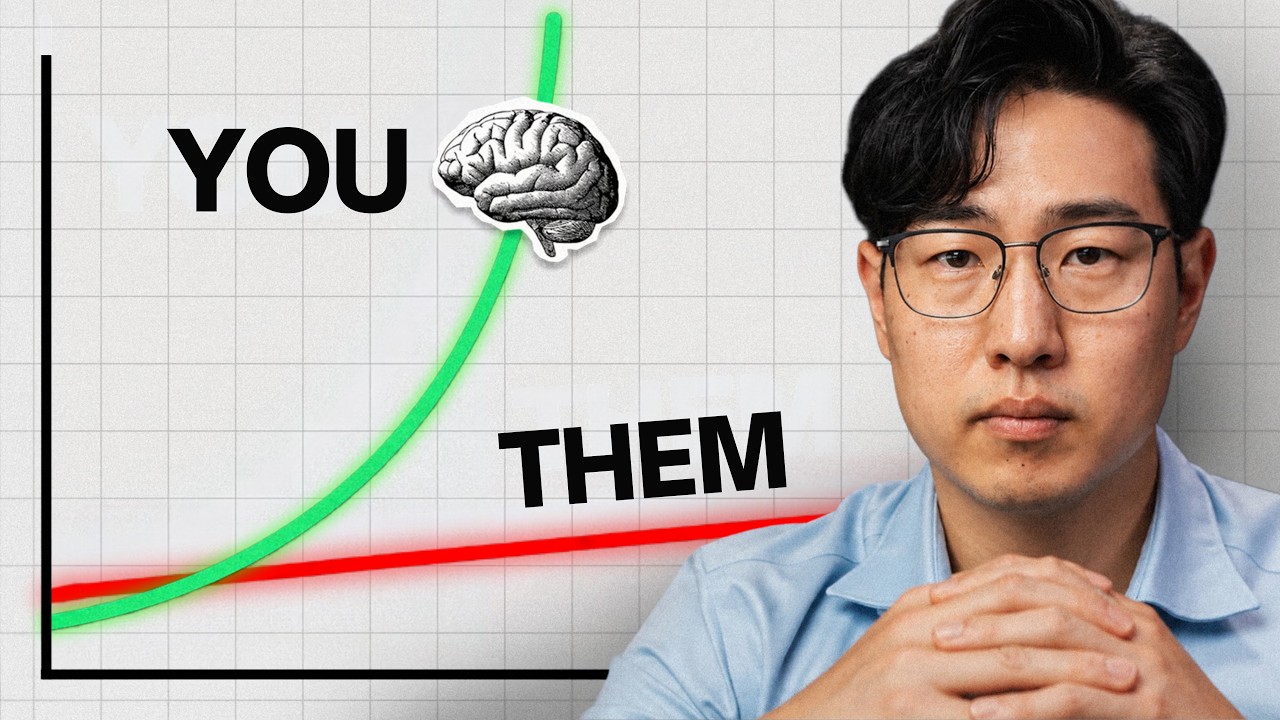
He compares coverage speed (how fast you read or cover material) with 'time to outcome' (the total time required to reach actual mastery or desired results).
[03:00 - 04:00] The Role of Rehearsal
Justin discusses how covering material quickly often leads to poor retention, requiring extensive rehearsal, which ultimately increases the total time to outcome.
[04:00 - 05:00] Why Slower Coverage is Faster
He explains that techniques with slower initial coverage speeds can be faster overall because they dramatically reduce the need for subsequent rehearsal.
[05:00 - 06:00] Case Study: Medical Student
Justin shares a story about a medical student who was worried about her slow study pace but actually achieved much higher retention and deep understanding.
[06:00 - 07:00] Taxonomies of Learning
Using Bloom's and SOLO taxonomies, Justin illustrates that fast but shallow reading only achieves low-level recall, whereas effective methods target high-level mastery.
[07:00 - 08:00] Method 1: Prediction Errors
Justin introduces the first method: increasing the frequency of prediction errors, which acts as a powerful signal to the brain to update and strengthen memory.
[08:00 - 09:00] How to Apply Prediction Errors
He demonstrates how to scan headings and keywords, pause, and actively make logical predictions about what the text will teach before actually reading it.
[09:00 - 10:00] The Power of Being Wrong
Justin explains that making predictions and being wrong creates a prediction error that naturally reinforces memory and builds deeper cognitive connections.
[10:00 - 11:00] Continuous Prediction and Newsletter
He emphasizes that prediction is an ongoing cycle throughout a study session and briefly introduces his weekly newsletter on learning strategies.
[11:00 - 12:00] Method 2: Multipass Encoding
Justin introduces the second method, multipass encoding, which advises against trying to understand everything on the first read.
[12:00 - 13:00] The Importance of Prior Knowledge
He discusses a famous study on baseball readers, showing that prior knowledge of a topic is a much stronger predictor of comprehension than general reading ability.
[13:00 - 14:00] Leveraging Prior Knowledge
Justin explains that prior knowledge is a controllable asset that can be built incrementally to make future learning significantly easier.
[14:00 - 15:00] How Multipass Encoding Works
He details the process of skimming for easy-to-understand concepts first, expanding your knowledge base, and then tackling harder concepts in subsequent passes.
[15:00 - 16:00] The Staircase Analogy
Using a staircase analogy, Justin explains that taking small, manageable steps is far more effective than trying to jump to the top floor all at once.
[16:00 - 17:00] Multipass vs. Linear Reading
He compares the speed and efficiency of multipass encoding with the slow, frustrating process of trying to read and understand a technical text linearly.
[17:00 - 18:11] Conclusion and Summary
Justin concludes by stating that these two methods make up 70% of his personal learning toolkit and encourages viewers to start applying them.
Full video: Watch on YouTube