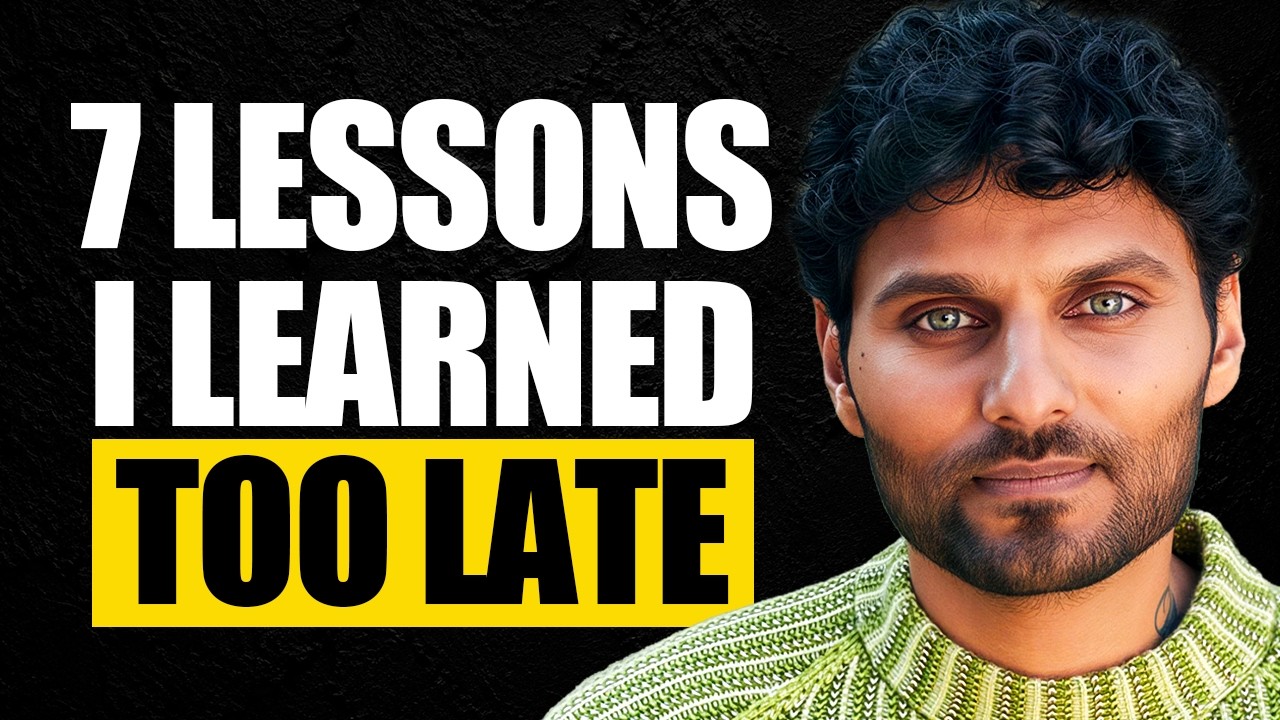
نص حلقة: If You're in Your 20s, Watch This BEFORE It's Too Late
Jay Shetty Podcast2026-09-30
If You're in Your 20s, Watch This BEFORE It's Too Late
Overview
Topic: Personal Development and Relationship Advice
In this episode, Jay Shetty shares seven crucial life lessons he wishes he had learned in his teens and twenties. He discusses the power of silence and active listening, the necessity of letting go of past grudges, the importance of direct communication in relationships, and how to evaluate a person's true character under stress. He also emphasizes setting boundaries, embracing personal growth even when it disrupts old dynamics, and decoding common relationship excuses to protect one's energy.
Minute by Minute (33)
[00:00 - 01:00] Introduction to the Seven Lessons
Jay Shetty introduces the concept of life lessons that are far more valuable than the subjects we learn in school, explaining how these insights can transform relationships, work performance, and purpose.
[01:00 - 02:00] Lesson 1: Speak Less, Mean More
Jay introduces the first lesson: 'The less you say, the more your words will matter.' He reflects on how he used to believe that the loudest person in the room held the most power.
[02:00 - 03:00] The Strength of Silence
Jay explains that silence is a strength rather than a weakness because it allows you to truly listen and understand others in social settings.
[03:00 - 04:00] How to Ask Better Questions
Jay discusses how asking generic questions leads to rehearsed answers, and suggests asking more engaging, thoughtful questions to build deeper connections.
[04:00 - 05:00] Sharing Thoughts to Invite Connection
Jay advises sharing your own thoughts or experiences first before asking a question, which naturally invites the other person to share and keeps their attention.
[05:00 - 06:00] Avoiding the Trap of Complaining
Jay warns against the habit of complaining immediately upon entering a room, as it spreads negativity and associates your presence with negative emotions.
[06:00 - 07:00] The Science of Conversation Memory
Jay references a Harvard study showing that people only remember a small fraction of what they hear in conversations, highlighting why brevity and impact are key.
[07:00 - 08:00] A Zen Story on Wisdom
Jay shares a Zen story about a student asking a teacher for the secret of wisdom, to which the teacher repeatedly replies with a single word: 'Listen.'
[08:00 - 09:00] Lesson 2: Let Go or Be Dragged
Jay introduces the second lesson: 'Let go or be dragged.' He explains the emotional toll of holding onto things, situations, or people that are no longer serving us.
[09:00 - 10:00] The Consequences of Clinging
Jay discusses how refusing to let go of someone doesn't stop them from living or changing, but it does drag you down and prevent your own progress.
[10:00 - 11:00] Release What Sinks You
Jay emphasizes that clinging to what hurts you will not save you; instead, it will sink you, poison your memories, and turn hope into suffering.
[11:00 - 12:00] Attachment vs. Love
Jay explains that unchecked attachment is like a chain, and neuroscience shows that holding onto resentment activates the same brain regions as physical pain.
[12:00 - 13:00] The Story of Two Monks
Jay shares a Zen story of two monks who encounter a drowning woman. One monk carries her to safety and sets her down, while the other monk continues to carry the mental burden of the event hours later.
[13:00 - 14:00] A Practical Exercise for Letting Go
Jay suggests a practical exercise: write down one grudge or disappointment you are holding onto and contemplate how much lighter you would feel if you set it down.
[14:00 - 15:00] Lesson 3: Direct Relationship Communication
Jay introduces the third lesson: 'Talk about your relationship with the person you're in a relationship with more than you talk to others.'
[15:00 - 16:00] The 80/20 Rule of Communication
Jay explains that 80% of relationship communication should happen directly with your partner, while only 20% should involve seeking outside counsel or advice.
[16:00 - 17:00] The Danger of Triangulation
Jay warns against emotional triangulation, where venting to friends instead of addressing issues directly with your partner worsens the problem rather than solving it.
[17:00 - 18:00] Lesson 4: Character Under Stress
Jay introduces the fourth lesson: 'You understand who someone is when they're stressed, not just when they're at their best.'
[18:00 - 19:00] Observing People on Bad Days
Jay explains that you don't truly know someone until you have seen them handle a bad day, a bad mood, or a situation where things do not go their way.
[19:00 - 20:00] How People Treat Others
Jay highlights the importance of observing how a person treats service workers, strangers, or handles minor inconveniences like traffic jams or late orders.
[20:00 - 21:00] True Character and Pressure
Jay notes that real character, loyalty, and respect are revealed when there is nothing to gain and when patience runs thin under pressure.
[21:00 - 22:00] The Orange Metaphor
Jay shares Wayne Dyer's orange metaphor: when you squeeze an orange, you get orange juice because that is what is inside. Similarly, pressure reveals what is truly inside a person.
[22:00 - 23:00] Lesson 5: You Get What You Accept
Jay introduces the fifth lesson: 'You don't get what you deserve, you get what you accept.' He discusses the importance of setting standards and boundaries.
[23:00 - 24:00] Making Your Efforts Clear
Jay explains that others will not automatically notice your hard work, sacrifices, or relationship efforts unless you establish clear boundaries and stand up for yourself.
[24:00 - 25:00] The Cost of Tolerating Boundary Violations
Jay cites a study showing that people who tolerate small boundary violations are significantly more likely to end up in emotionally exhausting relationships.
[25:00 - 26:00] The Farmer and the Storm
Jay shares a story of a farmer who accepts that a storm is coming and builds stronger walls, illustrating how accepting reality allows us to protect ourselves.
[26:00 - 27:00] Lesson 6: Outgrowing Old Versions of Yourself
Jay introduces the sixth lesson: 'Some people love the old version of you because they could control them.' He discusses the friction that personal growth can cause.
[27:00 - 28:00] Disrupting Unhealthy Systems
Jay explains that when you heal and grow, you disrupt the social systems and relationships that previously benefited from your wounds or compliance.
[28:00 - 29:00] Do Not Shrink to Fit In
Jay advises viewers never to shrink themselves to fit back into old spaces or apologize for evolving into a stronger, healthier version of themselves.
[29:00 - 30:00] Lesson 7: Decoding Excuses
Jay introduces the final lesson: 'I'm just bad at texting' is code for 'you're not a priority.' He talks about the futility of chasing people who do not make an effort.
[30:00 - 31:00] Translating Relationship Excuses
Jay decodes common relationship excuses, explaining how phrases like 'I'm confused' or 'I'm bad at communicating' often mean the other person is simply not invested.
[31:00 - 32:00] Believe Patterns, Not Promises
Jay emphasizes that people make time and effort for what they truly value, and urges viewers to believe a person's patterns of behavior over their promises.
[32:00 - 33:00] Conclusion and Final Thoughts
Jay wraps up the episode, hoping these seven lessons help viewers clear their minds, protect their energy, and build healthier, more meaningful relationships.
Full video: Watch on YouTube