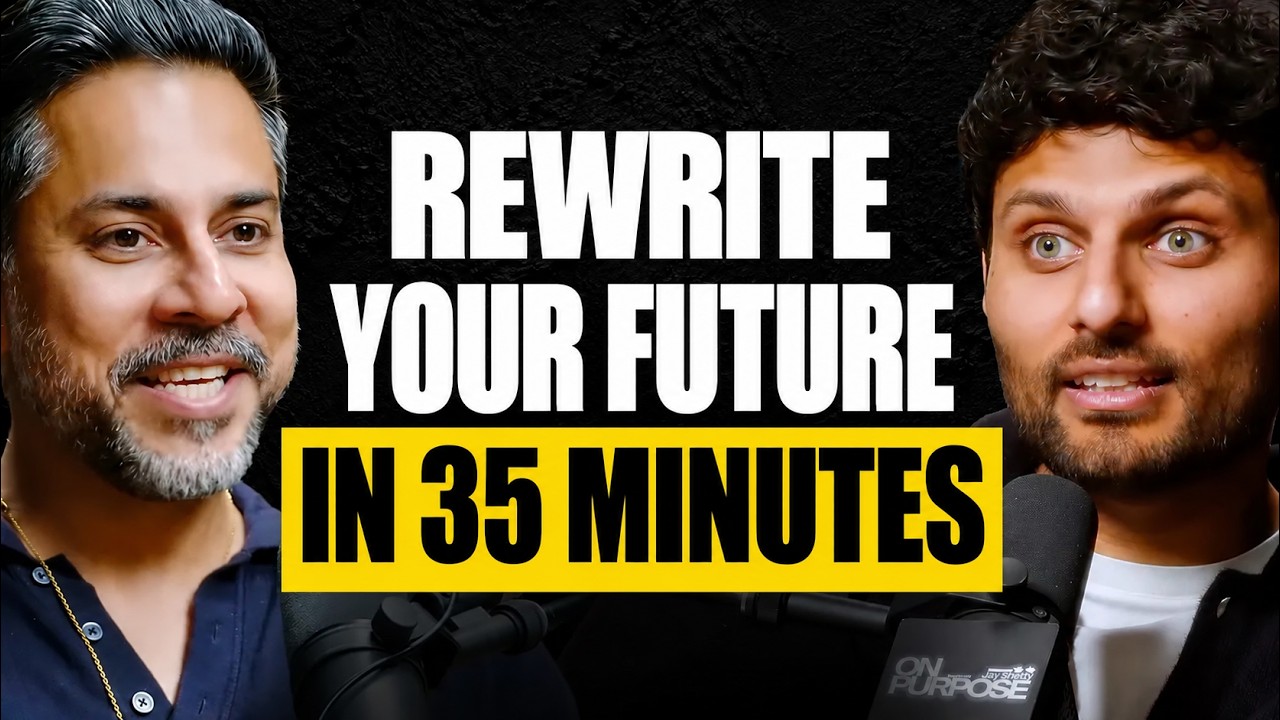
نص حلقة: Do This & You'll Never Worry About Money Again | Vishen Lakhiani
Jay Shetty Podcast2026-09-22
Do This & You'll Never Worry About Money Again | Vishen Lakhiani
Overview
Topic: Meditation and Personal Growth
In this episode, Jay Shetty sits down with Vishen Lakhiani, the founder of Mindvalley, to discuss the transformative power of meditation, the science of compassion, and the 6 Phase Meditation Method. Vishen shares his personal journey from Silicon Valley to becoming a spiritual teacher, explaining how active meditation can be used to solve real-world problems. They delve into the concepts of 'bliscipline,' the importance of forgiveness, and how to manifest a future vision by focusing on the 'what' and 'why' rather than the 'how.'
Minute by Minute (33)
[00:00 - 01:00] Secular Spirituality
Vishen Lakhiani shares his first experience with meditation and how he initially found traditional religious practices boring, leading him to explore secular spirituality.
[01:00 - 02:00] The Silva Method
Vishen discusses how Jose Silva's structured, actionable approach to meditation fascinated him and introduced him to active meditation.
[02:00 - 03:00] Active vs. Passive Meditation
Vishen explains the difference between active and passive meditation, highlighting how active meditation is used to solve real-life problems.
[03:00 - 04:00] Career Transformation
Vishen shares how the Silva Method transformed his career in Silicon Valley and inspired him to become a meditation teacher.
[04:00 - 05:00] The 6 Phase Meditation
Vishen introduces the concept of the 6 Phase Meditation, explaining how it serves as a daily tool to put individuals in a peak state.
[05:00 - 06:00] The Science of Compassion
Vishen explains the scientific benefits of compassion and love, citing studies from the HeartMath Institute on heart resonance.
[06:00 - 07:00] Training Compassion
Vishen describes how compassion can be trained like a muscle and how it shifts one's physiological state to a healthier mode.
[07:00 - 08:00] A Lesson in Empathy
Vishen shares a personal story about a waitress during the pandemic to illustrate how compassion changes one's perspective on daily frustrations.
[08:00 - 09:00] Seeing Humanity
Vishen continues his story, explaining how a state of appreciation and empathy allows one to see the humanity in others.
[09:00 - 10:00] Kindness as Strength
Vishen discusses how kindness and compassion are often underestimated but are actually signs of ultimate strength and leadership.
[10:00 - 11:00] Jay's Compassion
Vishen shares a humorous story about Jay Shetty's compassion during a Mindvalley festival in Ibiza.
[11:00 - 12:00] Technique vs. State of Being
Vishen explains the difference between a meditation technique and a quality of being, defining the circle of compassion.
[12:00 - 13:00] The Concept of Bliscipline
Vishen introduces the concept of 'bliscipline' and explains why happiness itself is not the ultimate goal.
[13:00 - 14:00] Embracing Sadness
Vishen discusses how sadness and melancholy can be beautiful, constructive emotions, referencing the movie Inside Out.
[14:00 - 15:00] Positivity Quotient
Vishen explains the Positivity Quotient (PQ) and how cultivating positive emotions improves workplace performance.
[15:00 - 16:00] Rockefeller's Poem
Vishen recites a poem by John D. Rockefeller that beautifully illustrates the essence of bliscipline and living without worry.
[16:00 - 17:00] Preventing Depression
Vishen explains how the first three phases of the 6 Phase Meditation—compassion, gratitude, and forgiveness—help prevent depression.
[17:00 - 18:00] Overcoming Guilt
Vishen discusses how to overcome guilt and shame through the practice of self-forgiveness.
[18:00 - 19:00] Brainwave States
Vishen explains the scientific connection between forgiveness and monk-like brainwave states, such as alpha coherence.
[19:00 - 20:00] Benefits of Forgiveness
Vishen highlights the physical and mental health benefits of forgiveness, including improved sleep and reduced anxiety.
[20:00 - 21:00] Avoiding Self-Sabotage
Vishen and Jay discuss the balance between self-forgiveness and avoiding self-sabotage or narcissism.
[21:00 - 22:00] Active Visions
Vishen explains why great spiritual teachers throughout history were not passive but had bold, active visions for the future.
[22:00 - 23:00] Visualizing the Future
Vishen discusses Phase 4 of the 6 Phase Meditation, which focuses on visualizing a future vision.
[23:00 - 24:00] Mature Wanting
Vishen explains the difference between mature and immature wanting when manifesting goals, advising to focus on the 'what' and 'why.'
[24:00 - 25:00] Unexpected Paths
Vishen shares how his own life path evolved from being an engineer to a storyteller and entrepreneur, showing that destiny unfolds in unexpected ways.
[25:00 - 26:00] The Lifebook Protocol
Vishen introduces the Lifebook protocol and how it helps individuals set holistic goals across 12 different categories of life.
[26:00 - 27:00] Holistic Goal Setting
Vishen explains how setting goals for character and emotional mastery is just as important as setting financial or career goals.
[27:00 - 28:00] Manifesting Dreams
Vishen shares how writing his Lifebook in 2010 led to the creation of the A-Fest festival and the manifestation of his dreams.
[28:00 - 29:00] Career as a Vehicle
Vishen emphasizes that a career is merely a vehicle for personal growth and that one must focus on the quality of life they want to lead.
[29:00 - 30:00] Satisfying Meditation
Vishen defines a satisfying meditation as one where the six qualities of the 6 Phase Meditation are expressed in daily life.
[30:00 - 31:00] Daily Evaluation
Vishen outlines the six questions to ask oneself at the end of the day to evaluate the success of their meditation practice.
[31:00 - 32:00] Testing Destiny
Vishen explains how to test the parameters of destiny by identifying what one would do even if they weren't getting paid.
[32:00 - 33:00] Coming Alive
Vishen warns against following the herd and pursuing careers that lead to clinical depression, urging people to find what makes them come alive.
Broadcaster Questions (11)
[00:00] What was your first meditation experience ever? Do you remember it?
Context: Jay Shetty asks Vishen Lakhiani about his very first introduction to meditation.
[00:11] How do you view meditation, like what is its use in your life today?
Context: Jay Shetty asks Vishen about the personal utility and purpose of meditation in his daily life.
[05:12] Can you talk to me about how you had this epiphany that compassion was a beginning?
Context: Jay Shetty asks Vishen to explain why compassion is the starting point of his meditation method.
[11:42] What is the difference between a technique and a pure intention?
Context: Jay Shetty asks Vishen to distinguish between a meditation technique and a state of being.
[12:37] Is happiness in your eyes still a goal, is it a pursuit, is it a byproduct, what is happiness?
Context: Jay Shetty asks Vishen about his perspective on happiness and its role in life.
[16:04] What has been the most depressing state that you've been in that the 6 Phase Meditation Method has helped you out of?
Context: Jay Shetty asks Vishen about his personal struggles with depression and how meditation helped him.
[17:22] How do you stop sadness from developing into guilt?
Context: Jay Shetty asks Vishen how to prevent healthy sadness from turning into toxic guilt.
[21:24] What is the 6 Phase version of vision?
Context: Jay Shetty asks Vishen to explain how the future vision is structured in his meditation method.
[26:58] How can people find the courage and strength to become new things and not feel held back by old things?
Context: Jay Shetty asks Vishen how individuals can transition into new phases of life without fear.
[31:19] What defines for you now a good meditation? What is a satisfying meditation?
Context: Jay Shetty asks Vishen how he evaluates the success of a meditation session.
[33:06] How do you test the parameters of your destiny?
Context: Jay Shetty asks Vishen how one can discover and align with their true life purpose.
Full video: Watch on YouTube