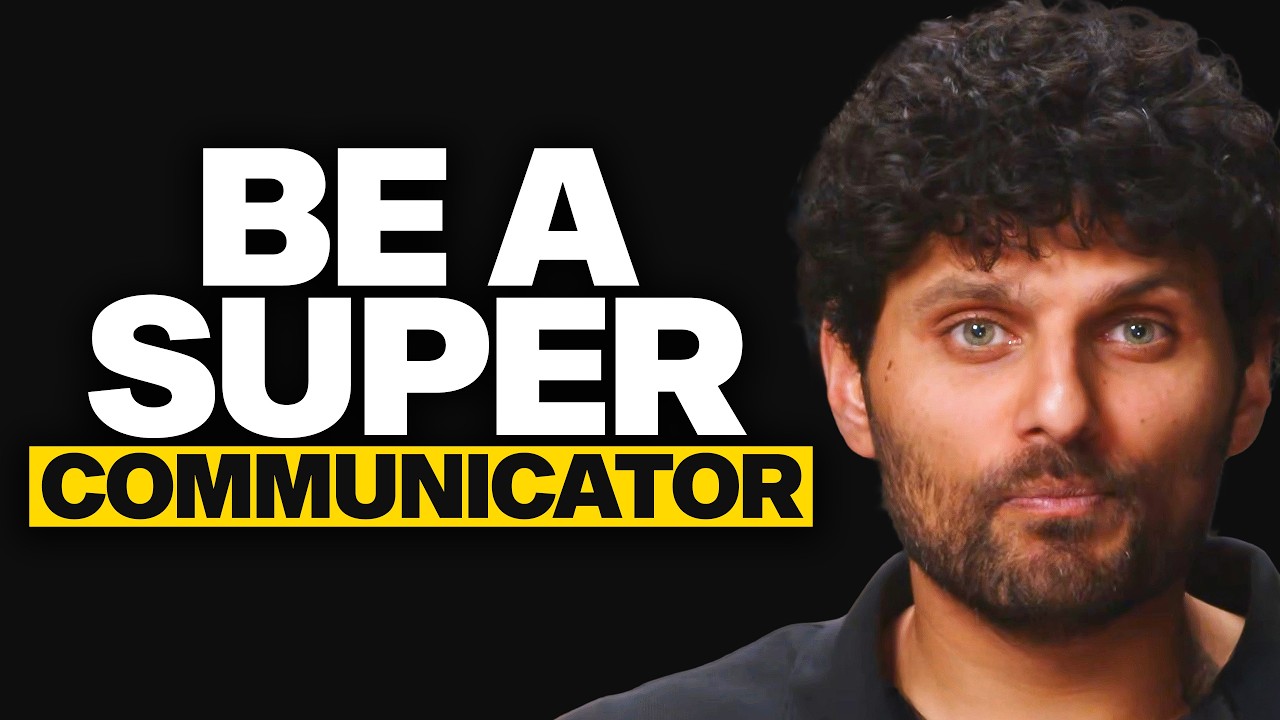
How to Communicate So People Actually Listen
Overview
Topic: Effective Communication Principles
Jay Shetty shares six science-backed principles to improve communication at work, home, and in life. He explains how to regulate emotions before speaking, prioritize clarity over intensity, reduce perceived threats, ask open-ended questions, align tone with intention, and close conversations with clear alignment.
Minute by Minute (23)
[00:00 - 01:00] Introduction to Communication
Jay Shetty introduces the topic of communication and asks the audience if they feel unheard at work, home, or with friends.
[01:00 - 02:00] The Gap in Communication Clarity
Jay discusses a Harvard study showing that people overestimate how clearly they communicate by more than 40%.
[02:00 - 03:00] Intention vs. Impact
Jay explains that communication is about shared understanding and what lands with the listener, rather than just self-expression.
[03:00 - 04:00] Principle 1: Regulate Before You Communicate
Jay introduces the first principle, explaining the neuroscience of how stress shifts brain activity away from reasoning and language.
[04:00 - 05:00] Reacting vs. Responding
Jay explains that reacting out of activation or trigger often worsens situations and makes others less willing to listen.
[05:00 - 06:00] The Power of the Pause
Jay highlights how effective communicators use pauses to regulate themselves and protect the outcome of the conversation.
[06:00 - 07:00] Principle 2: Clarity Beats Intensity
Jay introduces the second principle, noting that concise communication is perceived as more competent and trustworthy than emotional intensity.
[07:00 - 08:00] Simplifying Your Message
Jay quotes Albert Einstein on simplicity and explains that simple communication is a sign of deep understanding.
[08:00 - 09:00] Principle 3: Threat Shuts Down Listening
Jay introduces the third principle, explaining that when people feel embarrassed, judged, or blamed, their brains stop listening.
[09:00 - 10:00] Lowering the Threat Level
Jay discusses how to lower threat levels in conversations at work and home to prioritize understanding over self-protection.
[10:00 - 11:00] Creating Safety for Truth
Jay emphasizes that safety must be established before truth can land, and that people need to feel considered rather than corrected.
[11:00 - 12:00] Principle 4: Questions Change Everything
Jay introduces the fourth principle, explaining how asking open-ended questions reduces defensiveness and invites collaboration.
[12:00 - 13:00] The Role of AI in Asking Better Questions
Jay reflects on how the rise of AI has highlighted the human value of asking better questions and prompts.
[13:00 - 14:00] Lowe's Spring Fest Promotion
Jay presents a promotional segment for Lowe's Spring Fest, highlighting deals on mulch and major appliances.
[14:00 - 15:00] Principle 5: Tone Carries More Than Words
Jay introduces the fifth principle, citing research that tone and body language carry more meaning than words in emotional situations.
[15:00 - 16:00] Aligning Tone with Intention
Jay explains how to adjust vocal tone, pace, and volume to match the desired outcome of connection, clarity, or collaboration.
[16:00 - 17:00] Principle 6: Close the Loop
Jay introduces the final principle, emphasizing the importance of ending conversations with clear alignment and next steps.
[17:00 - 18:00] Structuring Conversations Like a Movie
Jay compares structuring the beginning and end of a conversation to the opening and closing of a movie to build emotional connection.
[18:00 - 19:00] Review of Principles 1-3
Jay reviews the first three principles: regulating before speaking, choosing clarity over intensity, and reducing threat.
[19:00 - 20:00] Compassionate Communication
Jay contrasts compassionate communication, which meets people where they are, with over-intellectual communication aimed at impressing others.
[20:00 - 21:00] Review of Principles 4-6
Jay reviews the final three principles: asking more questions, matching tone to intention, and ending with alignment.
[21:00 - 22:00] The Goal of Communication
Jay concludes by reminding the audience that the goal of communication is to be understood without losing the relationship.
[22:00 - 23:00] Outro and Preview
Jay wraps up the episode and shares a preview of his upcoming conversation with Adam Grant on unlocking hidden potential.
Broadcaster Questions (8)
[00:15] How many of you feel unheard at work?
Context: Jay Shetty introduces the common struggle of feeling unheard in different areas of life.
[00:18] How many of you feel unheard at home?
Context: Jay Shetty continues to ask the audience about where they feel unheard.
[00:20] How many of you feel like you can never get a word in when you're around your friends, or you can't command authority in a team meeting?
Context: Jay Shetty highlights common scenarios where people struggle to communicate effectively.
[11:37] Can you tell me what you heard from what I just said?
Context: Jay Shetty suggests asking this question instead of accusing someone of not listening.
[11:43] What do you think would make this work better?
Context: Jay Shetty suggests using this question instead of stating that something isn't working.
[15:44] What do you want from this conversation? What do you want from this connection? Do you want impact? Do you want growth? Do you want a solution? Do you want movement? Or do you just want more chaos?
Context: Jay Shetty prompts the audience to reflect on their true goals when entering a difficult conversation.
[16:19] Wait, what did we decide? Are we on the same page? Did that actually resolve anything?
Context: Jay Shetty describes the confusing thoughts people often have at the end of a poorly closed conversation.
[20:44] What do you think the goal is of what we're trying to achieve? What do you think is really important on this project? How do you think we're measuring success here?
Context: Jay Shetty provides examples of open-ended questions to align goals and expectations on a team project.
Full video: Watch on YouTube