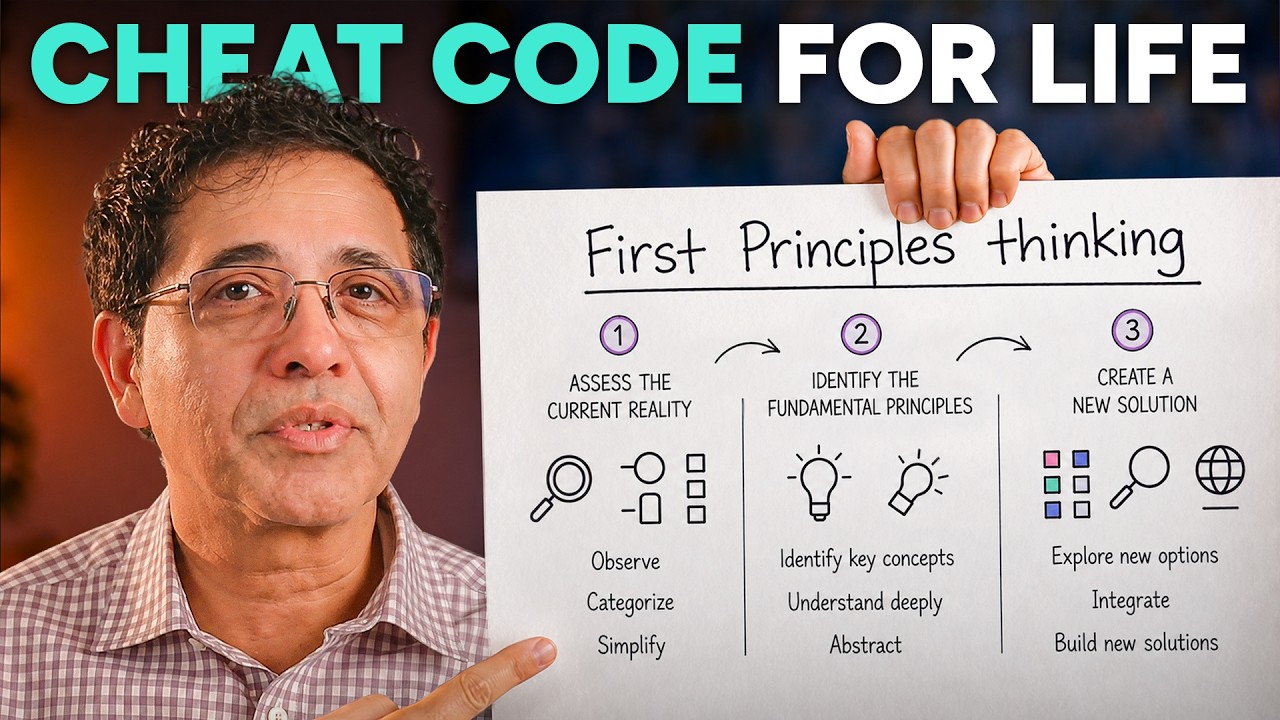
نص حلقة: Every High Performer Should Think In First Principles, Here's Why
Sandeep Swadia2026-08-27
Every High Performer Should Think In First Principles, Here's Why
Overview
Topic: First Principles Thinking and AI Prompting
Sandeep Swadia introduces the D.A.R.E. (Decompose, Audit Assumptions, Recombine, Experiment) framework for First Principles Thinking. He shares personal anecdotes about overcoming sleep apnea and historical business examples from Toyota, Tesla, and Dyson to show how questioning core assumptions leads to breakthrough innovations. He also provides detailed prompt templates using the AIM (Actor, Input, Mission) framework to guide AI models to think from first principles rather than relying on average pattern-matching.
Minute by Minute (19)
[00:00 - 01:00] Introduction to First Principles Thinking
Sandeep Swadia introduces First Principles Thinking as a life cheat code used by high performers like Elon Musk and Kobe Bryant. He introduces the D.A.R.E. framework.
[01:00 - 02:00] Sandeep's Personal Story of Exhaustion
Sandeep shares his experience as a high-performing CEO who worked long hours, slept very little, and woke up completely exhausted every morning.
[02:00 - 03:00] The Sleep Study Discovery
Sandeep describes undergoing a sleep study that revealed he was waking up 34 times an hour because his jaw structure was blocking his airway.
[03:00 - 04:00] The Assumption Trap
Sandeep explains how he solved his sleep issue by deconstructing the problem from first principles, and introduces the 'Assumption Trap' using Elon Musk's rocket design as an example.
[04:00 - 05:00] How AI Thinks
Sandeep discusses how large language models work by pattern matching and why they do not naturally think in first principles unless forced to do so.
[05:00 - 06:00] Step 1: Decompose
Sandeep introduces the first step of D.A.R.E.: Decompose. He uses the example of starting a YouTube channel to show how conventional wisdom differs from first principles.
[06:00 - 07:00] The AIM Framework
Sandeep explains that starting a YouTube channel only requires a phone and a story, and introduces the AIM (Actor, Input, Mission) framework for prompting AI.
[07:00 - 08:00] The Decomposition Prompt
Sandeep details the prompt structure for Decomposition, instructing the AI to act as a first-principles analyst and break down problems without offering premature solutions.
[08:00 - 09:00] Defining the Mission
Sandeep continues explaining the Decomposition prompt, focusing on defining the mission and hierarchy of parts.
[09:00 - 10:00] Step 2: Audit Assumptions
Sandeep transitions to the second step: Audit Assumptions. He uses the history of Toyota's post-WWII recovery to illustrate auditing assumptions.
[10:00 - 11:00] Toyota and Tesla's Innovations
Sandeep explains how Toyota's questioning of mass production assumptions led to Just-in-Time production, and how Tesla later questioned Toyota's assumptions.
[11:00 - 12:00] True Innovation and AI Auditing
Sandeep explains that true innovation requires breaking rules and ignoring conventions, and introduces the prompt for Auditing Assumptions.
[12:00 - 13:00] The Audit Assumptions Prompt
Sandeep details the Audit Assumptions prompt, instructing the AI to act as a skeptical red team analyst to uncover load-bearing assumptions.
[13:00 - 14:00] Step 3: Recombine
Sandeep introduces step three: Recombine. He uses music (12 notes in Western music vs. microtones in Indian/Arabic music) to explain recombination.
[14:00 - 15:00] The Recombine Prompt
Sandeep explains how Bach, the Beatles, and Beyoncé used the same 12 notes differently, and introduces the Recombine prompt for AI.
[15:00 - 16:00] Step 4: Experiment
Sandeep introduces step four: Experiment. He discusses James Dyson's 5,127 prototypes and Google's experiments with shades of blue.
[16:00 - 17:00] The Experiment Prompt
Sandeep details the Experiment prompt, instructing the AI to act as a skeptical scientist to design cheap, fast real-world tests.
[17:00 - 18:00] Summary of D.A.R.E.
Sandeep summarizes the D.A.R.E. framework and emphasizes that AI does the work while humans keep the judgment.
[18:00 - 18:50] Martin Short's Advice on Failure
Sandeep shares Martin Short's advice on failure rates and concludes with an encouraging message about finding the 2% that works.
Broadcaster Questions (11)
[03:13] What do I actually know for sure?
Context: Sandeep lists the fundamental questions to ask when starting first principles thinking.
[03:15] What am I assuming?
Context: Sandeep lists the fundamental questions to ask when starting first principles thinking.
[03:17] What else could produce this result?
Context: Sandeep lists the fundamental questions to ask when starting first principles thinking.
[03:20] Which part can I test?
Context: Sandeep lists the fundamental questions to ask when starting first principles thinking.
[03:44] Why couldn't the rocket land vertically and fly again?
Context: Sandeep explains how Elon Musk questioned the assumption that rockets must be discarded after one use.
[10:07] Why make big cars?
Context: Sandeep lists the assumptions Toyota audited when designing their post-WWII manufacturing strategy.
[10:09] Why produce them in huge batches?
Context: Sandeep lists the assumptions Toyota audited when designing their post-WWII manufacturing strategy.
[10:11] Why do you need to hold such a large inventory?
Context: Sandeep lists the assumptions Toyota audited when designing their post-WWII manufacturing strategy.
[10:15] What do you do when there's a defect?
Context: Sandeep lists the assumptions Toyota audited when designing their post-WWII manufacturing strategy.
[10:17] Are there different, better ways to organize the processes and people?
Context: Sandeep lists the assumptions Toyota audited when designing their post-WWII manufacturing strategy.
[10:52] Why do we need a combustion engine at all?
Context: Sandeep explains how Tesla questioned the fundamental assumption of car manufacturing.
Full video: Watch on YouTube